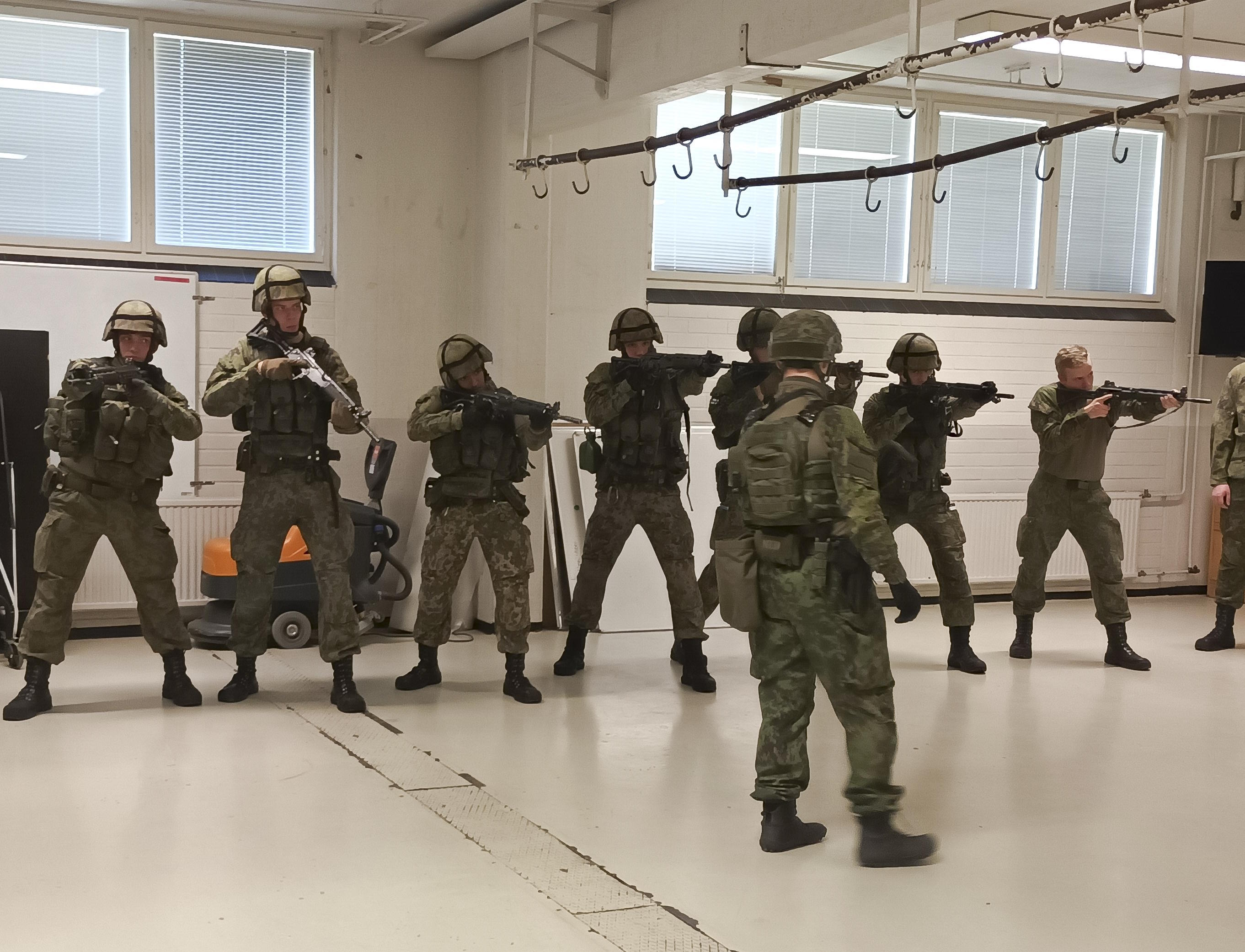
-Why do you do military service?
-Because it's for my country, for Finland.
-And because it's mandatory, right?
-Yes, but even if it weren't, I would still come. It's my duty. Our parents and grandparents did it too.
Nicholas and Alexandre are two young men just 20 years old who are indeed completing mandatory military service at the National Defense University of Finland in Santahamina. And there, in front of a group of European media, with EL MUNDO as the only Spanish representative, they display astonishing confidence about their obligation to their country's security. Both will complete a total of nine months of service, more than the minimum required. They do not rule out continuing their careers within the Army. And in them, as well as in the general population, the fixation is always the same: Russia.
Finland was dominated by the Russian Empire for just over a century, fought two wars against the USSR for which it had to cede part of its territory, and during the Cold War, Finnish foreign policy was always heavily influenced by Moscow. It shares a 1,340-kilometer border with Russia, the longest of any EU state and NATO member. And now they are completely sure that Vladimir Putin will not stop, far from it, with his aggression towards Kiev. They fear further aggression and are very aware that they are one of the main targets.
That is why they also have an extensive network of civil shelters that in the case of Helsinki form an alternative city underground. "There are more than 50,000 civil protection facilities across the country with a capacity of nearly 5 million people," explains a source from the Finnish Security Committee. This is very close to the 5.6 million that make up the country's total population.
"But in the capital, there is space for over 900,000 people, when the population is just over 700,000. In total, there are more than 5,000 shelters," they continue from the Security Committee, while noting that the facilities are now being made "much friendlier for children."
In the past, bunkers and shelters were inhospitable places, unwelcoming and frightening for the little ones. But now they are completely different. Some of them, like the one in Merihaka that this newspaper has also visited, feature indoor soccer fields, hockey rinks, gyms, parking, playgrounds, and Wi-Fi access 20 meters underground. They are used year-round, maximizing the enormous space, and in case of needing to seek shelter, children, as well as adults, will be completely familiar with the place.
The country's industry is also heavily oriented towards Defense, and Nokia is a prime example. The company responsible for the iconic 3310 has long stopped manufacturing phones. Last decade, it sold its mobile device division to Microsoft for over 5 billion euros and focused on telecommunications infrastructure and mobile networks.
From this emerged Nokia Defense, the company's Defense division, which is playing a crucial role in Europe's rearmament. One of its specialties is providing networks that allow for the detection and neutralization of enemy drones. Like the Russian ones, for example.
And also the icebreaker industry, which is the most advanced in Europe. In fact, it is almost the only one of vessels that will gain immense importance in the coming years. Global warming will open new trade routes and also military navigation. The European Commission has already warned that the EU must accelerate the acquisition of these ships, as the Union is significantly lagging behind the United States, China, and Russia.
The country's capabilities are so remarkable that even Donald Trump signed an agreement with them. "We are buying the best icebreakers in the world, and Finland is known for making them," stated the U.S. president in January. His close relationship with the country's president, Alexander Stubb, also helped, of course. And that same Finnish leader was the one who, at the end of last October, led, along with Norwegian Prime Minister Jonas Gahr Store, the phone conversations with Putin.
The move angered other European leaders, such as Danish Prime Minister Mette Frederiksen. And one might think that, given that shadow, that eternal threat from Russia, attempting to approach Putin from Finland could be contradictory. But diplomatic sources from the country maintain the opposite: "Values versus pragmatism". Moscow will remain a threat. Always. But peace, they argue, requires dialogue.